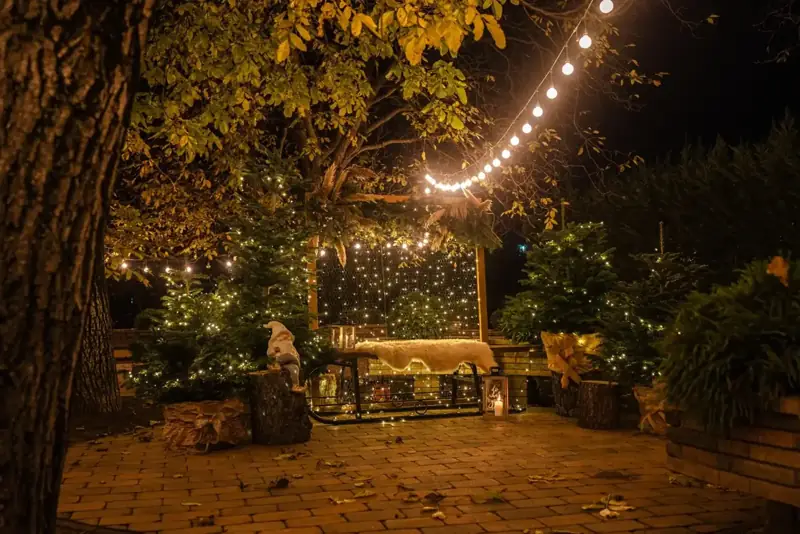
A patio under a canopy of bulbs is one of the most satisfying weekend projects there is. Knowing how to hang outdoor string lights properly, though, is the difference between a crisp, gently swagged canopy and a droopy line that snaps loose in the first storm.
This guide covers the whole job: planning the layout, choosing anchors, running a guide wire, building simple poles, no-nail options for renters, and wiring everything safely. Most patios take an afternoon and a helper.
Plan your layout first
Before you buy a single hook, sketch the space from above and mark your power outlet and every possible anchor point: house fascia, fence posts, pergola beams, sturdy trees.
Popular patio string light ideas
- Zigzag: lights crisscross between two long sides. Great coverage over a dining area.
- Perimeter: lights trace the edge of the patio. Simple, needs the fewest anchors.
- Parallel runs: straight lines from the house to a fence or posts, like a cafe.
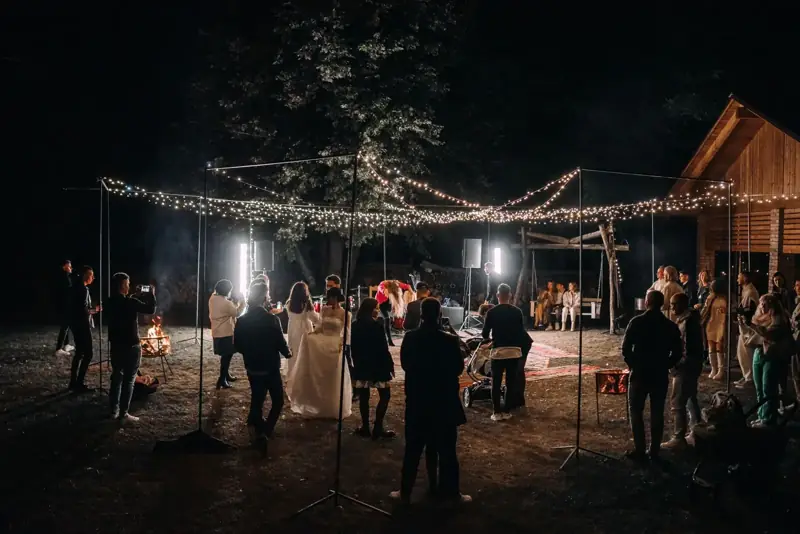
- Canopy or maypole: runs fan out from one tall center pole to points around the edge, creating a tent shape.
Measure each run and add about 10% for sag and the trip to the outlet. Our planner below adds up the total length, number of strands and anchor points for your layout.
Patio string light planner
Enter your space, choose a hanging pattern and get the strand count, bulbs and anchor points, with a plan drawing.
Includes about 10% for a gentle drape and 6 ft to reach the outlet. Check the maximum number of strands your lights can link end to end.
Height, spacing and sag
A few rules of thumb keep the result looking polished:
- Height: aim for the lowest point of each run to sit at least 7 to 8 feet above the ground, higher over walkways, so nobody bumps their head.
- Sag: a slight drape looks best. Plan roughly 6 to 12 inches of drop on a 20-foot span. Too tight and the cord strains; too loose and it looks sloppy.
- Spacing: parallel or zigzag runs look even when spaced 4 to 8 feet apart.
- Span: unsupported runs longer than about 20 to 25 feet benefit from a guide wire.
Gather your hardware
- Outdoor-rated string lights (look for a weather rating such as IP44 or higher) and shatterproof bulbs
- Galvanized or stainless steel guide wire, about 1/16 to 1/8 inch thick
- Screw eyes or eye lag screws for wood; masonry anchors for brick
- Turnbuckles for tensioning, plus wire rope clips or crimp sleeves
- Outdoor zip ties, S-hooks or snap clips
- Tape measure, drill, ladder, wire cutters and pliers
- Outdoor-rated extension cord and an outdoor timer or smart plug
How to hang outdoor string lights with a guide wire
A guide wire carries the weight so the light cord never does. It is the single best upgrade for long or windy spans.
Test the lights
Plug every strand in on the ground first. Replace dead bulbs now, not from a ladder.
Install anchors
Drive screw eyes into solid wood: fascia boards, rafter tails, posts or beams. On a house, aim for framing, not thin trim. Pre-drill to avoid splitting.
Run the guide wire
Hook a turnbuckle (opened most of the way) to the first anchor. Thread the wire through it, loop back and secure it with two wire rope clips. Stretch the wire to the second anchor, loop it through and clamp it.
Tension it
Twist the turnbuckle until the wire is taut with only a slight sag. Don't overtighten; wood anchors can pull loose.
Attach the lights
Starting at the end nearest your power source, clip or zip-tie the light cord to the wire at every bulb socket or every 12 to 18 inches. Let the bulbs hang down.
Trim and tidy
Cut zip-tie tails flush, and leave a little slack at each anchor so the cord is never pulled tight.
Poles: when there's nothing to attach to
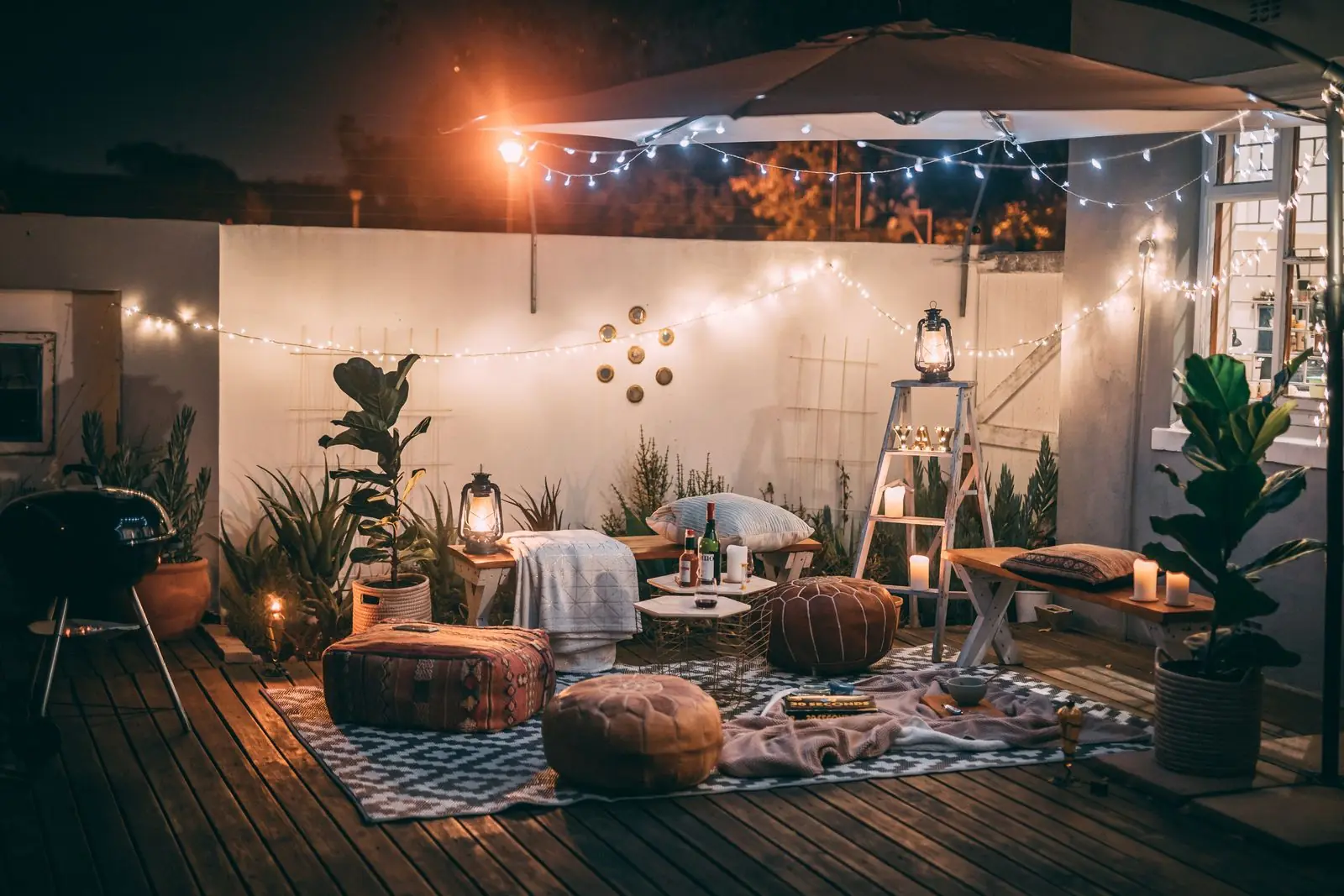
Open lawns and patios away from the house need posts. You have three easy options.
Planter poles
Set a 4×4 wooden post or a sturdy metal pole, 8 to 10 feet long, in a large planter or a 5-gallon bucket filled with concrete. Drop the bucket inside a decorative planter and top it with soil and plants. Fix a screw eye or hook near the top.
In-ground posts
For a permanent setup, dig post holes about 2 feet deep and set the posts in concrete. Call your local utility-locating service before digging.
Ready-made light poles
Store-bought string light poles with ground spikes or deck clamps go up fastest. They suit lawns with soft soil and decks with railings.
How to hang string lights without nails
Renting, or don't want holes in siding? These no-drill methods work well:
- Gutter hooks: clip onto the gutter lip and hold the cord along the roofline.
- Outdoor adhesive hooks: fine for lightweight fairy lights and short runs; clean the surface first and respect the weight rating.
- Tree straps: wrap a nylon strap or a padded rope around the trunk instead of nailing into the bark.
- Railing clamps: clamp-on poles or brackets grip deck railings without screws.
- Shepherd hooks and planter poles: freestanding, so nothing touches the house.
- Umbrella hubs: run lights from a patio umbrella pole out to nearby anchors for a quick canopy.
For smaller-scale outdoor sparkle along railings and shrubs, our waterproof fairy lights guide covers copper wire strings that need nothing more than a few clips.
Power and electrical safety
Outdoor lights and electricity need a little respect.
- Plug into a GFCI-protected outdoor outlet with a weatherproof cover.
- Use only extension cords rated for outdoor use, and keep connections off the ground.
- Leave a drip loop where the cord enters an outlet or connection: a small downward loop so water drips off before reaching the plug.
- Check the strand's label for the maximum number of connected strands and stay under it.
- Add an outdoor timer or smart plug so the lights turn on at dusk and off at bedtime.
Care through the seasons
Inspect lights each spring for cracked sockets and frayed cords. Tighten turnbuckles as wires stretch. In regions with heavy snow or ice, take strands down for winter and leave the guide wire in place; rehanging next year then takes minutes. Store lights loosely coiled around a piece of cardboard to prevent tangles.
Swapping to LED bulbs, if your strand still uses incandescent ones, cuts power draw dramatically and lets you connect more strands end to end. Shatterproof plastic bulbs are worth it anywhere children play or branches can swing into the lights.
Wrap-up
Plan the layout, carry the weight on a guide wire, give each run a gentle sag and power it safely, and your patio lights will look good for years. For more inspiration, see our fairy lights vs string lights comparison, browse outdoor fairy lights for smaller accents, or plan a celebration with our wedding lighting ideas.