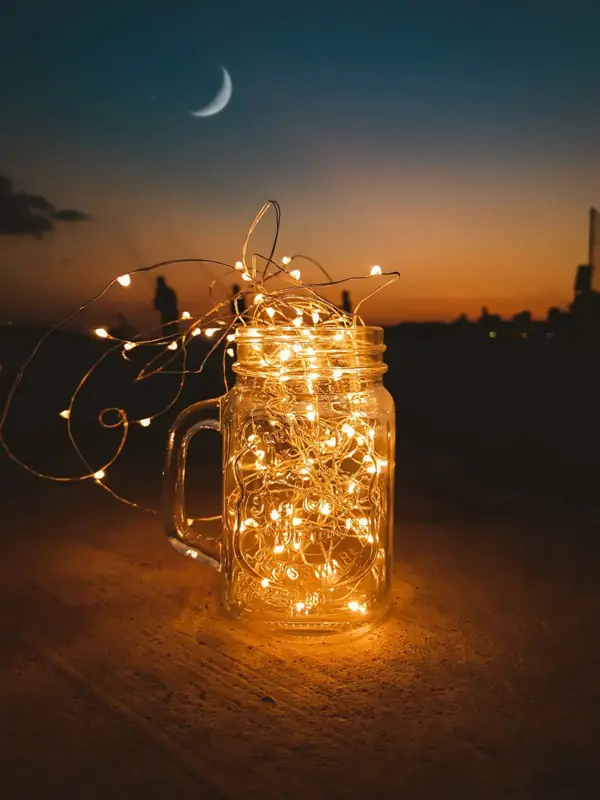
So you've strung a set of battery fairy lights across a shelf, and now you're wondering when they'll fade out. How long do battery fairy lights last? For a typical micro LED string on fresh AA batteries, expect roughly 24 to 72 hours of continuous glow, and several weeks if you use the built-in timer.
That range is wide because the answer depends on the battery type, the number of LEDs, the mode you choose and even the temperature of the room. This guide walks through each factor, gives you a quick way to estimate your own string, and shares the habits that keep lights bright longer.
How long do battery fairy lights last? The short answer
Here are typical ranges for common setups running on steady mode. Treat them as ballpark figures; your exact string may differ.
| Setup | Battery | Typical continuous runtime |
|---|---|---|
| 20–30 micro LEDs | 2×AA alkaline | 48–96 hours |
| 50 micro LEDs | 3×AA alkaline | 24–72 hours |
| 100 micro LEDs | 3×AA alkaline | 12–36 hours |
| 20 LEDs in a jar lid | 2×CR2032 coin cells | 6–20 hours |
| Any string | USB power bank, 10,000 mAh | Several days to a week or more |
With a 6-hours-on, 18-hours-off timer, those same strings last about four times as many calendar days, because they only draw power a quarter of the time.
What decides fairy light battery life
Battery capacity
Capacity is measured in milliamp-hours (mAh). A typical alkaline AA holds around 2,000–2,500 mAh at the light loads fairy lights draw. A coin cell like a CR2032 holds only around 200–240 mAh, which is why coin-cell lights fade so quickly.
Wiring batteries in series (as most packs do) raises voltage, not capacity. Three AAs give about 4.5 V, but the pack still holds roughly the capacity of one AA.
Number of LEDs and current draw
Every LED pulls a little current. A 50-light micro string commonly draws somewhere in the range of 30–100 mA. Double the LEDs and you roughly double the draw, which halves the runtime.
Mode
Steady-on draws the most. Twinkle, slow fade and flash modes spend part of the time dimmed or off, so they often run longer. Strings with a dimmer setting also stretch battery life at lower brightness.
Temperature
Alkaline batteries lose a large chunk of their usable capacity in freezing weather. Outdoor lights in winter can quit in half the time they would indoors. Lithium AA batteries hold up far better in the cold.
Estimate your own runtime
You can get a rough number with a simple formula:
Hours ≈ battery capacity (mAh) ÷ current draw (mA) × 0.7
The 0.7 accounts for the fact that lights dim and cut out before a battery is completely empty. For example, a 2,400 mAh AA pack running a string that draws 60 mA gives about 2,400 ÷ 60 × 0.7 = 28 hours of steady light.
Don't know your current draw? Some packaging lists it. If not, the calculator below lets you plug in LED count, battery type and timer settings for a quick estimate.
Fairy light battery life calculator
Estimate how long a battery-operated string will glow. Move the sliders and watch the lights.
Estimate based on about 0.75 mA per micro LED at full brightness and 85% usable capacity. Cold weather and cheap cells shorten runtime.
Rechargeable vs alkaline batteries
Choosing the right cell can matter more than any other setting.
| Type | Voltage per cell | Strengths | Watch out for |
|---|---|---|---|
| Alkaline AA | 1.5 V, slowly dropping | Cheap, everywhere, long shelf life | Gradual dimming, poor in cold, can leak |
| NiMH rechargeable AA | 1.2 V, steady | Reusable hundreds of times, steady brightness | Slightly dimmer at the start, self-discharge in storage |
| Lithium AA (non-rechargeable) | 1.5 V, very steady | Longest runtime, light, great in cold | Higher upfront cost |
NiMH cells start a little dimmer because of their lower voltage, but they stay at that level until nearly empty, while alkalines fade gradually. For lights you run every night, low-self-discharge NiMH rechargeables save money and waste. For outdoor winter displays, lithium AAs are the most reliable.
Timer modes: the easiest way to add weeks
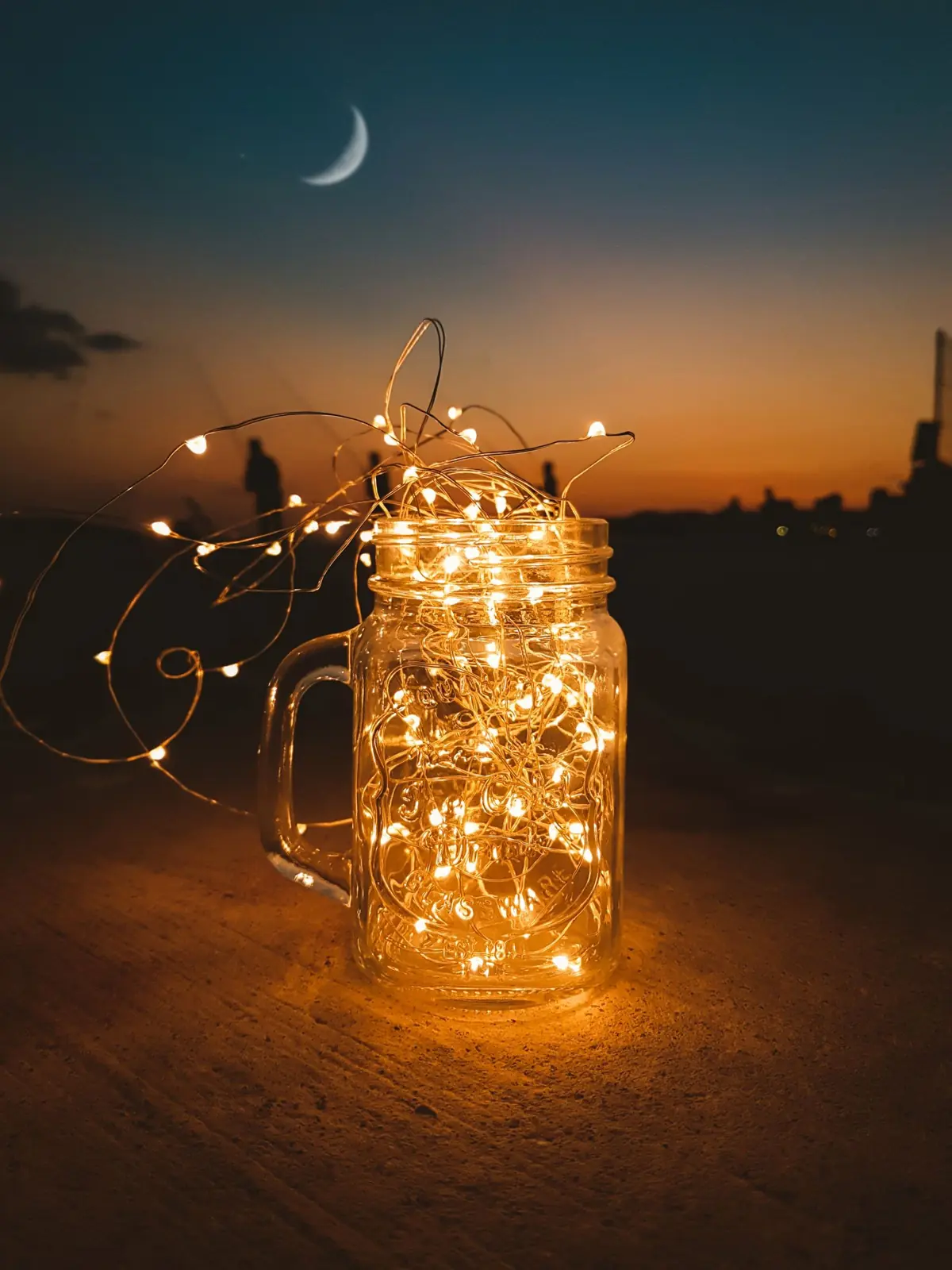
Most battery fairy lights now include a 6-hours-on, 18-hours-off timer. Switch it on at the time you want the lights to come on each day, say 5 p.m., and they will repeat that cycle automatically.
- A string that lasts 30 hours steady will give about five evenings on the timer, instead of a little over one day.
- Set the timer at the right moment. Many strings start the cycle the instant you press the button, so press it at dusk, not at noon.
- Remote-controlled strings often offer more timer lengths (2, 4, 6 or 8 hours). Shorter cycles stretch batteries even further.
- Remotes themselves keep a tiny receiver awake, so a remote string switched "off" with the remote still uses a trickle of power. Use the physical switch when storing.
Habits that make batteries last longer
- Use a slower mode or the dimmer level when full brightness isn't needed.
- Pick a shorter string for small spaces; a jar rarely needs more than 20–30 lights.
- Keep outdoor packs out of direct rain and, in winter, use lithium cells.
- Remove batteries before storing lights for more than a few weeks.
- Wipe the battery contacts with a dry cloth if the lights flicker.
- Consider a USB string and a power bank for lights you run for long periods.
Signs your batteries are nearly done
Battery fairy lights rarely cut out all at once. Watch for these clues so you can swap cells before an event rather than during it:
- Warm white turns slightly orange or dull. As voltage falls, white LEDs lose their crispness first.
- Twinkle modes stutter. The little controller chip may reset or skip steps when power sags.
- The timer forgets itself. Some strings lose their 24-hour cycle when voltage drops too low.
- Lights glow only when you jiggle the pack. That points to loose or corroded contacts, not empty batteries.
If you are lighting a party or wedding table, start with a fresh set the same day. It costs little and saves a scramble when the room goes dark halfway through dessert.
When battery lights aren't the best choice
If you want lights glowing all evening, every evening, for a whole season, batteries become a chore. A USB string powered by a wall adapter or a plug-in set will never need a swap. Solar strings suit gardens with good sun. Battery lights shine in places with no outlet: jars, wreaths, centerpieces, costumes and tabletop displays.
For outdoor displays, look for a sealed battery box with a rubber gasket. Our outdoor fairy lights guide covers waterproof packs and timers, and the battery operated garland guide explains how to tuck packs into greenery.
Wrap-up
Battery fairy lights usually last a day or three of steady glow, and weeks with a timer. Choose lithium or NiMH cells, use a timer and keep strings sized to the job, and you'll rarely be caught in the dark. Ready to put them to work? Try our 5-minute mason jar fairy lights project, browse battery operated fairy lights, or use the calculator on the light tools page anytime.